


Page 42 - 7. State Of Environment Report Of Türkiye
P. 42
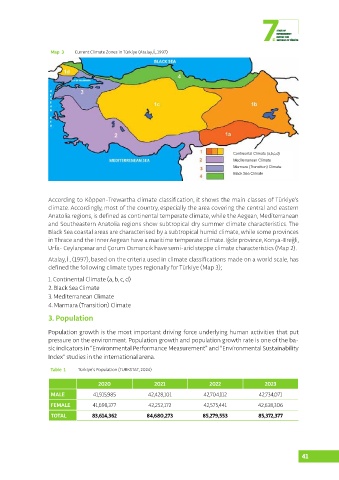
Map  3  Current Climate Zones in Türkiye (Atalay, İ., 1997)


                                                                                   Continental Climate (a,b,c,d)
                                                                                   Mediterranean Climate
                                                                                   Marmara (Transition) Climate
                                                                                   Black Sea Climate


                  According to Köppen-Trewartha climate classification, it shows the main classes of Türkiye’s
                  climate. Accordingly, most of the country, especially the area covering the central and eastern
                  Anatolia regions, is defined as continental temperate climate, while the Aegean, Mediterranean
                  and Southeastern Anatolia regions show subtropical dry summer climate characteristics. The
                  Black Sea coastal areas are characterised by a subtropical humid climate, while some provinces
                  in Thrace and the Inner Aegean have a maritime temperate climate. Iğdır province, Konya-Ereğli,
                  Urfa- Ceylanpınar and Çorum Osmancık have semi-arid steppe climate characteristics (Map 2).
                  Atalay, İ., (1997), based on the criteria used in climate classifications made on a world scale, has
                  defined the following climate types regionally for Türkiye (Map 3);
                  1. Continental Climate (a, b, c, d)
                  2. Black Sea Climate
                  3. Mediterranean Climate
                  4. Marmara (Transition) Climate
                  3. Population


                  Population growth is the most important driving force underlying human activities that put
                  pressure on the environment. Population growth and population growth rate is one of the ba-
                  sic indicators in “Environmental Performance Measurement” and “Environmental Sustainability
                  Index” studies in the international arena.

                   Table  1  Türkiye’s Population (TURKSTAT, 2024)

                                    2020               2021                2022               2023

                   MALE           41,915,985         42,428,101          42,704,112         42,734,071
                   FEMALE         41,698,377         42,252,172         42,575,441          42,638,306
                   TOTAL         83,614,362          84,680,273         85,279,553          85,372,377


                                                                                                           41

