


Page 232 - 7. State Of Environment Report Of Türkiye
P. 232
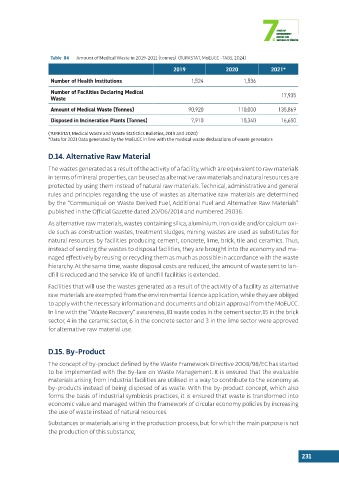
Table  84  Amount of Medical Waste in 2019-2021 (tonnes)  (TURKSTAT, MoEUCC -TABS, 2024)
                                                              2019              2020            2021*

                   Number of Health Institutions                    1,524              1,536
                   Number of Facilities Declaring Medical                                           17,935
                   Waste
                   Amount of Medical Waste (Tonnes)                90,920            110,000       135,869

                   Disposed in Incineration Plants (Tonnes)         7,910             10,340        16,650

                  (TURKSTAT, Medical Waste and Waste Statistics Bulletins, 2019 and 2020)
                  *Data for 2021 Data generated by the MoEUCC in line with the medical waste declarations of waste generators

                  D.14. Alternative Raw Material

                  The wastes generated as a result of the activity of a facility, which are equivalent to raw materials
                  in terms of mineral properties, can be used as alternative raw materials and natural resources are
                  protected by using them instead of natural raw materials. Technical, administrative and general
                  rules and principles regarding the use of wastes as alternative raw materials are determined
                  by the “Communiqué on Waste Derived Fuel, Additional Fuel and Alternative Raw Materials”
                  published in the Official Gazette dated 20/06/2014 and numbered 29036.
                  As alternative raw materials, wastes containing silica, aluminium, iron oxide and/or calcium oxi-
                  de such as construction wastes, treatment sludges, mining wastes are used as substitutes for
                  natural resources by facilities producing cement, concrete, lime, brick, tile and ceramics. Thus,
                  instead of sending the wastes to disposal facilities, they are brought into the economy and ma-
                  naged effectively by reusing or recycling them as much as possible in accordance with the waste
                  hierarchy. At the same time, waste disposal costs are reduced, the amount of waste sent to lan-
                  dfill is reduced and the service life of landfill facilities is extended.

                  Facilities that will use the wastes generated as a result of the activity of a facility as alternative
                  raw materials are exempted from the environmental licence application, while they are obliged
                  to apply with the necessary information and documents and obtain approval from the MoEUCC.
                  In line with the “Waste Recovery” awareness, 81 waste codes in the cement sector, 15 in the brick
                  sector, 4 in the ceramic sector, 6 in the concrete sector and 3 in the lime sector were approved
                  for alternative raw material use.


                  D.15. By-Product

                  The concept of by-product defined by the Waste Framework Directive 2008/98/EC has started
                  to be implemented with the By-law on Waste Management. It is ensured that the evaluable
                  materials arising from industrial facilities are utilised in a way to contribute to the economy as
                  by-products instead of being disposed of as waste. With the by-product concept, which also
                  forms the basis of industrial symbiosis practices, it is ensured that waste is transformed into
                  economic value and managed within the framework of circular economy policies by increasing
                  the use of waste instead of natural resources.
                  Substances or materials arising in the production process, but for which the main purpose is not
                  the production of this substance;


                                                                                                           231

