


Page 341 - 7. State Of Environment Report Of Türkiye
P. 341
facturers to place only safe products on the market, while also authorizing public institutions to
               regulate and implement product-specific legislation.
               Market surveillance and inspection (PGD) was prepared as one of the opening criteria of the
               “Free Movement of Goods” chapter in the EU membership negotiations. The products for which
               the General Directorate of EIA, Permit and Inspection is responsible are solid fuels, as per the “Na-
               tional Market Surveillance and Inspection Strategy”, which was prepared by taking the opinions
               of producer and consumer organizations as well as PGD institutions and was accepted by the
               Market Surveillance and Inspection Coordination Board (PGDKK) upon the recommendation of
               the Market Surveillance and Inspection Coordination Board (PGDKK).
               Solid fuel inspections, which are the responsibility of the Ministry of Environment, Urbanization
               and Climate Change and the institutions/organizations to which authority has been transferred,
               are carried out within the scope of the Environmental Law No. 2872 and the secondary legisla-
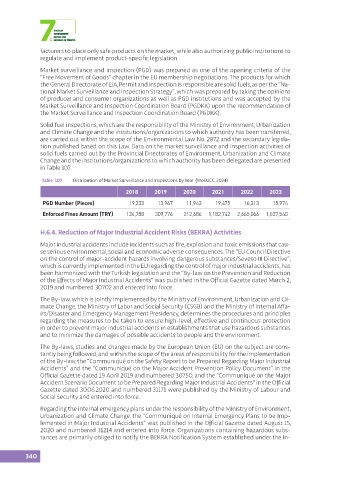
               tion published based on this Law. Data on the market surveillance and inspection activities of
               solid fuels carried out by the Provincial Directorates of Environment, Urbanization and Climate
               Change and the institutions/organizations to which authority has been delegated are presented
               in Table 107.

                Table  107  Distribution of Market Surveillance and Inspections by Year  (MoEUCC, 2024)
                                             2018      2019      2020       2021      2022      2023

                PGD Number (Pieces)           19,233    13,967     11,943    19,475    16,313    15,974
                Enforced Fines Amount (TRY)  134,788   309,776    212,686  1,182,742  2,665,066  1,837,540


               H.6.4. Reduction of Major Industrial Accident Risks (BEKRA) Activities

               Major industrial accidents include incidents such as fire, explosion and toxic emissions that cau-
               se serious environmental, social and economic adverse consequences. The “EU Council Directive
               on the control of major-accident hazards involving dangerous substances/Seveso III Directive”,
               which is currently implemented in the EU regarding the control of major industrial accidents, has
               been harmonized with the Turkish legislation and the “By-law on the Prevention and Reduction
               of the Effects of Major Industrial Accidents” was published in the Official Gazette dated March 2,
               2019 and numbered 30702 and entered into force.

               The By-law, which is jointly implemented by the Ministry of Environment, Urbanization and Cli-
               mate Change, the Ministry of Labor and Social Security (ÇSGB) and the Ministry of Internal Affa-
               irs/Disaster and Emergency Management Presidency, determines the procedures and principles
               regarding the measures to be taken to ensure high-level, effective and continuous protection
               in order to prevent major industrial accidents in establishments that use hazardous substances
               and to minimize the damages of possible accidents to people and the environment.

               The By-laws, studies and changes made by the European Union (EU) on the subject are cons-
               tantly being followed, and within the scope of the areas of responsibility for the implementation
               of the By-law, the “Communiqué on the Safety Report to be Prepared Regarding Major Industrial
               Accidents” and the “Communiqué on the Major Accident Prevention Policy Document” in the
               Official Gazette dated 19 April 2019 and numbered 30750, and the “Communiqué on the Major
               Accident Scenario Document to be Prepared Regarding Major Industrial Accidents” in the Official
               Gazette dated 30.06.2020 and numbered 31171 were published by the Ministry of Labour and
               Social Security and entered into force.

               Regarding the internal emergency plans under the responsibility of the Ministry of Environment,
               Urbanization and Climate Change, the “Communiqué on Internal Emergency Plans to be Imp-
               lemented in Major Industrial Accidents” was published in the Official Gazette dated August 15,
               2020 and numbered 31214 and entered into force. Organizations containing hazardous subs-
               tances are primarily obliged to notify the BEKRA Notification System established under the In-


          340

