


Page 121 - 7. State Of Environment Report Of Türkiye
P. 121
Due to the fact that the greenhouse gases in the atmosphere are permeable to the incoming
               solar radiation, but much less permeable to the long-wave ground radiation emitted back, the
               natural process that enables the earth to warm up more than expected and regulates the heat
               balance is called the natural greenhouse effect.
               The United Nations Framework Convention on Climate Change (UNFCCC) and its Kyoto Protocol
               (KP) require the control of six major greenhouse gases (CO , CH  N O, Hydrofluorocarbons-HFC,
                                                                     2
                                                                          4,
                                                                            2
               Perfluorocarbons-PFC and Sulphurhexafluoride-SF ). Chlorofluorocarbons-CFC and Hydrochlo-
                                                              6
               rofluorocarbons-HCFC, which cause ozone depletion in the stratosphere, are controlled by the
               Montreal Protocol.
               In the fight against climate change, the main policies and measures that come to the forefront
               are concentrated in the energy, transport, industrial processes, agriculture, waste and land use
               and forestry sectors.

               B.1. General Climate Data

               B.1.1 Precipitation Distribution of Türkiye
               The average annual areal precipitation in Türkiye is 573 mm (1991-2020). According to the long-
               term averages, the highest precipitation in Türkiye is over 1,600 mm in Rize and Artvin coasts of
               the Eastern Black Sea Region, while the lowest precipitation is observed in the central parts of
               Central Anatolia and around Şanlıurfa, Ağrı and Iğdır (Map 8).
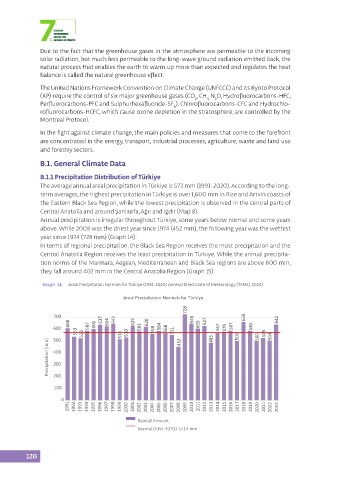
               Annual precipitation is irregular throughout Türkiye, some years below normal and some years
               above. While 2008 was the driest year since 1974 (452 mm), the following year was the wettest
               year since 1974 (728 mm) (Graph 14).
               In terms of regional precipitation, the Black Sea Region receives the most precipitation and the
               Central Anatolia Region receives the least precipitation in Türkiye. While the annual precipita-
               tion norms of the Marmara, Aegean, Mediterranean and Black Sea regions are above 600 mm,
               they fall around 402 mm in the Central Anatolia Region (Graph 15).

                Graph  14  Areal Precipitation Normals for Türkiye (1991-2020) General Directorate of Meteorology (TSMS), 2024)
                                            Areal Precipitation Normals for Türkiye

                                                                  728
                    700                                                                659
                         608      601  637  624  642  625  620       646  605  627                 642
                    600         587               581    584  568             567  575  587  585
                            553  523        514  530   558    551  452      483      503    500  525  504
                    500
                  Precipitation [mm]  400


                    300

                    200
                    100

                       0
                         1991  1992  1993  1994  1995  1996  1997  1998  1999  2000  2001  2002  2003  2004  2005  2006  2007  2008  2009  2010  2011  2012  2013  2014  2015  2016  2017  2018  2019  2020  2021  2022  2023


                                                 Rainfall Amount
                                                 Normal (1991-2020): 573.4 mm


          120

